Showing posts with label planning. Show all posts

Tuesday, April 15, 2008

Downsizing.

If you've been following my mutterings long enough, you'll know that I originally set out to make a modern narrow gauge line in the Black Forest in 1:43 scale, using 16.5mm (HO) track. In theory this scale is great for making making narrow gauge trains: you get hold of old HO/OO scale models: you take the top off, build your own slightly larger superstructure on the chassis, and you have a narrow gauge locomotive (and if you chose the right model, a body you can hack up for later projects as well) This is fine as far as it goes, but small HO/OO wheels can look a bit silly under a big locomotive, and with my grandiose designs, the Körschtalbahn's locomotives tend to be pretty big. (they are the same scale size as trains on the Zillertalbahn railway, although I don't think any of you believe me) One solution to this would be bigger chassis, from places like 'Hollywood Foundry'. Hopefully I'll be able to save up and get one soon, but until then I'll have to keep getting second hand models from places like Ebay or similar, so the wheel problem remains -especially with bogie chassis.

I reckon I've found a solution though. If I go down a bit in scale to 1:55, it brings everything down to a manageable size and things which are huge in the larger scale, suddenly look more reasonable, so I'm going to try building a couple of of 1:55 scale models and see how they turn out. 1:55 has been around for a very long time, and is often called "The Ffestiniog Scale" because it started with a series of kits from GEM based on the Ffestiniog and Talyllyn railways.
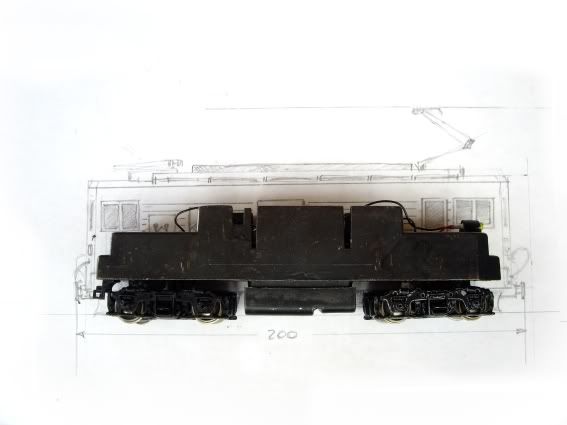


1:55 scale version: suddenly it fits...

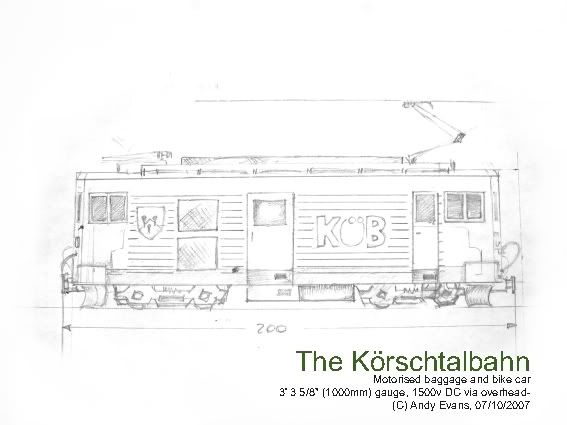
Once I can play trains on 'Westerooge' I'll make a start on this Rhaetian Bahn-esque motor luggage van, a model I've wanted to make since my first attempts at scratchbuilding in the 1990's. I eventually gave up because it always looked terrible in 1:43 scale when squeezed on to a HO gauge chassis, but when I tried it out in 1:55 I found that it fits rather well. Running on HO track, this would scale up at about 3 feet or 914mm. This is a bit small for metre gauge, but there are a few 900mm gauge railways around Germany, and anyway, I'm not going to worry about it too much- for some reason it bothers me less than tiny wheels.


I've been dithering about this for a while- building 'Westerooge' was partly to gain some experience in 1:43 so I have something to compare the result with (and also as an excuse for procrastination), but I did join the 5,5mm Association a while back, and they haven't thrown me out yet, despite my lack of interest in all things Ffestiniog. They are running a competition to build a micro layout this year, which I may just enter when I come back from the UK...

Wednesday, January 09, 2008

Layout inna box

Westerooge continues to develop and I'm confronted with the problem of how to get a feeling of wide open spaces in a box file. The best solution I can come up with is to make everything very simple, so my plan is to play about with one set of points and a couple of bits of track until I get a combination which seems to work, and then start building.

It also occured to me that don’t know what to use as an exit point. Westerooge is an uninhabited island, so it’s not like there’s a convenient café to hide the fiddle yard behind, nor are there any bridges, pipes or even large trees. I think the most likely solution is a dune or a dyke with a gap for the trains, and then a ramshackle workshop to serve for small repairs, a few more rolling dunes and if I'm feeling brave, just a hint of the North Sea on the backscene...

Maybe I'll just say it's foggy that morning and paint it grey...

Monday, October 22, 2007

Here Endeth the silence…

…Hopefully.

The “Big” project that I’ve been eating, breathing and sleeping for the last few weeks- “Baroness Isabella von Katzenberg’s evil and despicable plans for world domination” -finished last night with a pretty successful show. The team I work with dealt with all the last minute glitches and problems that beset these things with a level of patience and flexibility that would give some professional companies pause for thought and I’m really pleased with them, but I’m also rather glad it’s over and I have a bit of time to relax before the next one starts...

While I was working on that my shopkeeper friend has been stockpiling cardboard boxes. Lots and lots of them This means I can very probably make the baseboard for the model, so I expect this will take priority over the next week or so, although I hope I’ll be able to keep building stock. To give an idea of what can be done with a cardboard baseboard, here's an example built by Michael Mott in Canada, which he very kindly allowed me to reproduce here.


Having seen this I’m having second thoughts about starting with “Spitzenwald”, and wondering about a simple model with the railway running through a more undulating landscape: my thinking being that I’m trying out a lot of new methods, so having a simpler model is better if things really go poop. Possibly a bit pessimistic of me, but if it all goes swimmingly and works like a dream, I’ll have learnt a lot and have a nice model in the bargain. Either way I’ll be happy.


Friday, August 10, 2007

Developing 'Spitzenwald'

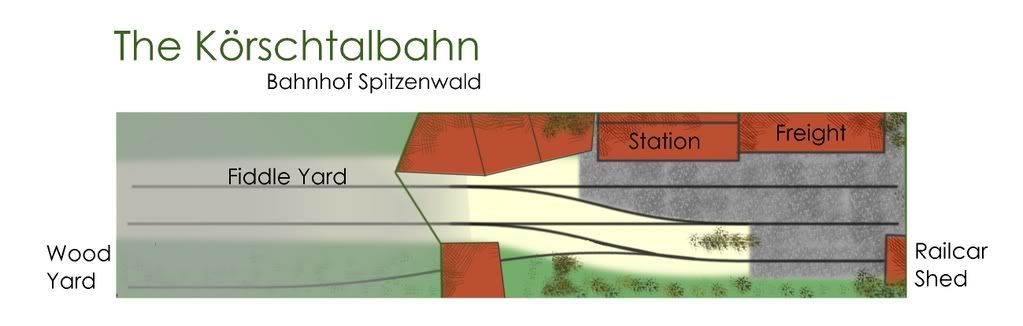
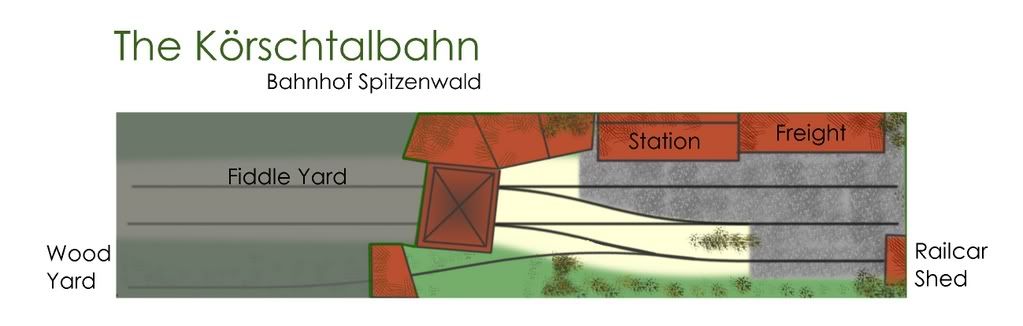
Carl Arendt emailed to suggest the plan I came up with for “Spitzenwald” would be impractical because the siding at the front blocked the fiddle yard. (I’m not claiming he reads the blog, I emailed a copy to him.) I could see his point, so if this siding is built it will now disappear into a low-relief building instead, giving access to the fiddle yard from the front and at the same time increasing the possible traffic this shed can take- I can now run open wagons into there and load them up with wood by hand for example, and then if I feel the desire, it can become something completely different with a change of sign. With that change I can just use the building as a scenic break which in turn dispenses with the overbridge and allows me to have a couple more buildings if I feel up to it… Thoughts and feedback welcome.

If you’re wondering, there is a lot more going on than drawing track plans on the Gimp: there are three wagon chassis on bogies and frames cut for a fourth, and as soon as the rain stops I’ll make a picture of them…

Wednesday, June 27, 2007

Spitzenwald

Let’s face it: you can have too many pictures of a white plasticard van, so I figure it’s time to introduce my ideas for “Spitzenwald”, the layout which will hopefully soon grace the Ikea shelves in our living room. The original plan was for an inglenook-style model, but that was replaced when I tried it out- running 64mm wide stock makes for big overhangs and effectively shortened the sidings. The current plan is partly plagiarised from Bob Hughes’ N-gauge “Altgarten” model –in particular his idea of putting the station and goods shed on the siding at rear. Bob also helped me to tweak a couple of details, which I’m grateful for. You can see the original "Altgarten" here.
During operation, I’d assume the two lines exiting the scene at left would be a loop, from which there would be access to an intermodal terminal. This wouldn’t be a big operation: probably just one siding with a concrete pad and a container crane, maybe a warehouse for more specialised deliveries or palletts:

Photo Sharing and Video Hosting at Photobucket
Container stacker at Nagold railway station, a few kilometres away from the Fictitious KÖB.
The "terminal" at Spitzenwald would be similar.

Of course in reality it will end in a couple of sidings or a traverser, depending on how brave I’m feeling at the time.
At the moment I’m leaning towards a wood yard as a scenic barrier in front of the fiddle yard, as wood is most likely to be the staple traffic of the line, (more on that at a later date). The road bridge may be reborn as an old city wall: this would be narrower and possibly more convenient as a scenic break, and could turn with the backscene a bit as well. It’s not unknown for railways to enter older towns this way in Germany.
The KÖB will also have a maintenance shed for railcars: This is common on the smaller independent railways here because the early commuter and school services need to start at this end of the branch. At the moment it’s one road but I may have a low relief door at the end of the middle road as well.

Photo Sharing and Video Hosting at Photobucket
Small railcar fuel and maintenance point in Endingen, near Freiburg, used by road and rail vehicles. I like the pump to the right of the door...

Behind this is the general freight shed, probably used by the local farmers cooperative. It would also be a place to unload post wagons. I expect the station will have been rented or sold, so people will have to get their tickets from a machine on the platform.
That’s the plan anyway. I now hesitantly offer it up for criticism, ideas, thoughts, and suggestions before I start gluing things to other things…

Tuesday, June 12, 2007

Driving to Altensteig…

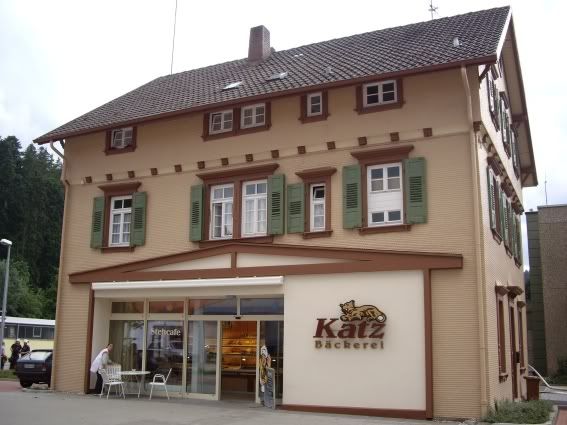
Former Terminus at Altensteig, now a bakery

Long ago the people of the Nagold valley (about 20km south of the fictional Körsch valley) transported their logs in rafts on the river, in similar style to American loggers. Here, river pilots would build a wooden dam with gates, wait until there was enough water, then open the gates and ride the wave for a few kilometres until the next dam. It must have been a pretty exciting existence: the mind boggles as to what happened when several tonnes of sodden pine came shoshing around the corner and met something unyielding. Nonetheless, until about 150 years ago this was the way of shifting wood from the Nagold to the Neckar river, and on to the Rhine and Holland. And to think now people pay to do this sort of thing.
All in all I expect most people were relieved to let the railway take over. The metre gauge line from Nagold to Altensteig opened in 1891, but only lasted until 1967 before the prevailing wisdom turned to roads. This seems a great shame as the town now has all manner of industry, not to mention tourists coming to the old city, so it seems sad they didn’t keep going with rail. All that is left of the railway is a few buildings, a wagon planted alongside the road, and a cycleway.


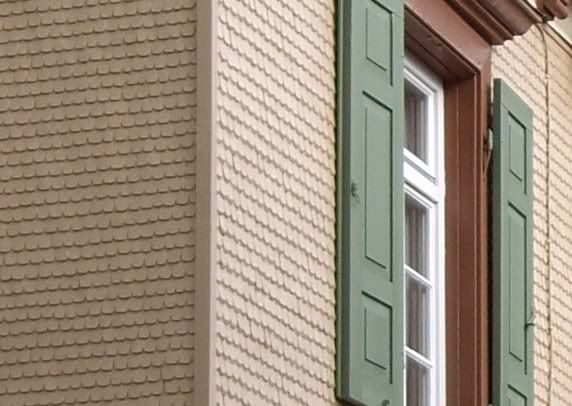
Station detail showing the intricate shingles... Perhaps I'll just have a plain wall...

All of which doesn’t leave a lot to go on. I was hoping to have a good look at the line and the area to get some thoughts on how the Körschtalbahn (KÖB) could have been constructed, how it could look, and what it could carry. Judging by the Altensteig line, the KÖB would have followed a road most of the way with occasional short detours through villages or round hills. By the looks of it, frequently lurching across the road would be in order as well. The stations are typical European pattern: Goods shed with station alongside, the sort of thing that should fit onto the back of the layout. The low-key way the railway squeezed between buildings is very attractive although I haven’t any ideas yet how to make it happen- perhaps have all the buildings a few degrees different to the track, to give an impression of “The buildings were here first” and possibly “added-on” loading bays to take advantage of the loading possibilities. I have some pictures of local building to give me an idea: I'll post those, along with some thoughts on traffic types soon.

Now. How do I make shingles?

[Update, 13th of June 2007: Our pastor (who grew up in Altensteig) loaned me book on the line so I can actually see what it looked like and where it ran. I'll read it through -which may take time as it's in German, and inflict my thoughts on you later]

Tuesday, May 15, 2007

Best laid plans?


"Spitzenwald" takes shape, sort of... This shows about half of the 1700mm X 400mm baseboard

We are home again, and I think I’m having a reaction to the lack of activity over the last three weeks. The wheels arrived for my wagons, and yesterday I played about with some points on the shelves that will hopefully soon be the home for “Spitzenwald”. I have been doodling on bits of paper while I was in Japan, and I've come up with a general operating plan, so I cut some old cereal packets out to represent different items of rolling stock and test if they’ll fit in the different sidings and headshunts I’d planned.

So far so good: I’ve got a few ideas together and it seems I can accomodate two coach trains (ie: railcar and trailer). I’ll post a track plan as soon as I can…