Monday, November 27, 2006

Finally, a cab...

After 3 attempts the cab sides for G1 are ready. I’ve not glued the lot together, but I couldn’t resist having a dry run to see how it looks. Hopefully the dodgy joins in the cab will disappear when it’s fixed properly. I don’t know what happened to the end of the short bonnet but it won’t go straight. The exhaust is a drinking straw, and I may try for a bigger diameter version. You’ll notice I’ve chickened out of interior details so far, and the railings. I think I need to move the buffers up a bit to fit the DG coupling in

More pictures on Flickr. Click on the photo to see them...

Paint.

The paint arrived last week. I'm using artist's acrylics because they are easier to get hold of in Germany. I've had a lot of advice from Dave Balcombe (of Teetering by the Well fame) and Colin Peake, builder of Shifting Sands, which I'm really grateful for, as I seem to have no colour sense. (Michiko, my wife is the opposite and has taken over home decoration, to the relief of all concerned) They suggest going for subdued colours and using brighter colours as tints with creams, browns and greys to keep the colours muted and together on the scenery. If I'm really persistent, maybe I can get Michi involved...

Wednesday, November 22, 2006

Slow progress…

I’ve made little visible progress in the last week or two. I’m waiting for the paint I ordered to come through, and in the meantime I’ve been looking for couplings that will work with my locos, and for modern 7mm figures.

The coupling problem is that I want to have link-and-pin couplings and automatic couplings working at the same time, which rules Kadee couplings out- they wouldn't fi t under that huge buffer. I’m hoping to build some transporter wagons one day and they will need to be coupled by a drawbar. In other words, I want to have the best of both worlds.

However, it seems I can get away with it. I’ve found that DG or B&B couplings will probably lurk unobtrusively under the buffers on G1, giving me the convenience of auto coupling and uncoupling, and still have prototypical coupling to drawbars.

I’ve also -with a lot of assistance from many different modellers- found a couple of sources for modern 7mm scale figures, which I was concerned about. One of them is actually quite close to where I live. Finally I’ve confirmed that the figures will be between 35 and 40mm tall which means my calculations for the doors (42mm, based on an assumption they would be a scale 6 feet) are correct. I’ve made the sides of the cab ready to fit. After painting...

Thursday, November 16, 2006

Körschtalbahn history part 2: 1901-1946

The second part of my entirely made up history of the Körschtalbahn. I suggest you start with the first part, here. Almost all the events in this story have happened on narrow or standard gauge railways in our region. I’ve just pushed them all together…

From the first ten years the line grew and the traffic forecasts were fulfilled, even exceeded by traffic returns. Several wood mills worked in the valley, and a steel works began production in Körschbrunnen. A mallet supplemented the two 0-6-0 tank engines in 1904. A second, heavier unit followed two years later. Together these powered up and down the Körschtal with their heavy wood trains.

However, there was now a problem. Coal costs money, and transporting the stuff cost more money. The directors had long been looking at the fast-flowing river Körsch and imagining the potential for cheap electricity. The more visionary ones were already drawing up cost/benefit analyses. In 1913 the decision was made to electrify the line, and the Körschtalbahn placed an order with the Esslingen Maschinenfabrik near Stuttgart for two electric c-c railcars.

In 1914 Electric power was switched on from Wildberg to Dachsburg. Originally it is clear that the directors wanted to have wires beyond the station at Dachsburg and up the final section to Spitzenwald, but the First World War intervened and steam remained on the upper section. The steam locomotives also continued to run on the lower Körschtal for freights that the railcars couldn’t handle. This did not stop the Government requisitioning first one and then both of the 0-6-0 tank engines for use on the Russian front, where they both disappeared. By the end of the war, the manpower difficulties had reduced the steam fleet to one Mallet, and the railcars were struggling with the increased traffic.

The chaos between the wars allowed for little investment, although two steeple cab locomotives were purchased second hand from a line in north Germany. As with all of the rest of Germany’s railways the Körschtalbahn came under national control in the 1930’s and for the next ten to fifteen years the story was one of overuse and under investment. Stone and wood were moved in huge quantities, so much so that two diesels were brought in to assist.

The Second World War would make depressing reading, so I’ll stick to saying that after the war the line was worn out. One Mallet was still operable and ran the whole length of the line when there were power failures, which were frequent. As the “Economic miracle” began to take place, and the industries grew in the Lower and Upper Körschtal, the line built up traffic, but it urgently needed new investment, new trains, and a complete overhaul of the infrastructure.

Continued on part 3.

Friday, November 10, 2006

Wood and Transhipment at Nagold


On Wednesday I had an appointment in Nagold, a town in the Black Forest. I went by train, of course.

Nagold is about ten kilometres south of Wildberg, where the fictional Körschtalbahn meets the real Nagoldtalbahn. It used to have its own narrow gauge railway running to Altensteig.

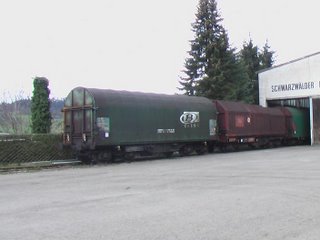
One of the reasons given for the demise of Narrow Gauge is the transhipment cost. It costs too much to tranship freight from standard gauge to narrow, and vice versa. The picture above shows a train of wagons (From Belgium, if you’re wondering), which have just been shunted into that shed for unloading; there’s apparently a freight train to Nagold, carrying different things every one or two days. The steel is put onto a truck and driven to a company based in Rohrdorf, who are steel distributors, and if that isn’t transhipment, I don’t know what is.

Rohrdorf is on the route of the old Narrow Gauge line. How much easier it would have been to simply shove those steel wagons onto transporters, or just transfer the load, onto narrow gauge wagons instead...
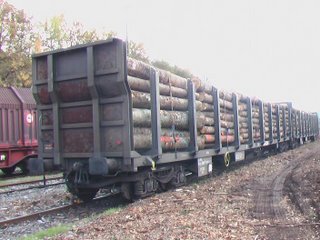

There are also wood trains. These Austrian wagons have clearly just been loaded, which conforms that the wood train I saw being loaded at Nagold on my last fleeting visit wasn't a one off.

I’ve got a few more pictures, which are on the Flickr gallery. I also got a brief look at Wildberg on the way through. It is a lot more mountainous than I thought, but there is a small valley running into the hills, which could easily be part of the Körschtalbahn. And the buildings are very distinctive and I didn’t have time to take photos.

Which just means I’ll have to go back again…

Thursday, November 09, 2006

New Links

I've just discovered that a blog I read has linked to me... It's just playing trains from John Sharp has me in his link section, which made a pleasant suprise. I'm also linked from the RJR Branchline by John Teal. Thanks for that!

Now I've really got to try and figure out HTML...

Monday, November 06, 2006

Taking Control...

Progress on G1 continues. I'm going to have to do some painting soon, find a driver to fit inside the cab. The great lump in the floor is the result of my not concentrating when I built the frames- I managed to put the biggest part of the motor there instead of under the bonnet... Hopefully it won't be too obvious when it's all painted. I've also realised my brilliant idea to use MSE Couplings won't work because they are designed to be in the middle if the buffer beam, right where the buffer is. However, it finally looks like a locomotive as opposed to a rail borne Skateboard. There's a few more views on my photo album, click on the picture to have a look.

Tuesday, October 31, 2006

Hoods for Growler 1


After five attempts at making decent hoods for growler 1 I’ve finally managed to get them to work out as I’d like. I came very close to a complete redesign of the loco with square bonnets but I was too stubborn to know when to give in. Even after one of the hoods was complete, it disintegrated when I tried to glue strengthening pieces to it. However, now that stage of the model is over and I can start thinking about the cab.

On top of that the model shop I ordered my track from has given up on Royal Snail postage and sent another batch of track- this time directly to Germany. Delivery expected at the end of this week.

Wednesday, October 25, 2006

Körschtalbahn history 1: 1891 to 1901

This is the first part of the history of the Fictitious Körschtalbahn. The Körschtal is a real valley that passes our village- but sadly it never contained a narrow gauge railway. All the details in this history are based on real railways somewhere local to the Körschtal, both standard gauge and narrow; and although the 1000mm line to Altensteig closed in 1969, a standard gauge railway run by DB still runs along the beautiful Nagoldtal.

The Körschtal (Körsch Valley) is a small steep sided gorge in the black forest, climbing eastwards from the Nagold Valley up to Dachsburg and Spitzenwald in the hills. In the 1890s the people of the Körschtal saw the industries growing in the Nagold Valley as the standard gauge railway was opened, and they felt that the timber from their forests, and the stone of their quarries was every bit as good as that being carried on the new railway in to Stuttgart and beyond for sale. Furthermore, they reasoned, their valley was at least as beautiful, if not more so than that of the river Nagold, and they felt that the people of the growing towns were being deprived of an excellent opportunity to see this beauty. Nagold was developing its tourism, and many rich hunters were coming to try their luck with the deer in the area. If, the people of the valley reasoned, they had a railway, the wood and stone could go to Stuttgart and the hunters could come and shoot things in the woods, and the Körschtal would prosper.

In 1891 the “Königlich Württembergischen Staats-Eisenbahnen” (The Royal Württemberg State Railways) opened a 1000mm gauge railway to the south, running from Nagold to Altensteig. This spurred the supporters of the Körschtalbahn and in 1893 a plan was put together for a narrow gauge railway, backed by several local towns, and the Government of Württemberg. In the event the main reason for the line was wood; on the broad Nagold river the wood was lashed together and transported downstream in large rafts, but the Körsch was a narrow mountain river, too narrow and rocky for transportation, so the logs had to be transported by cart on unmade roads.

The first cut was made on August the first 1897, and construction continued apace, reaching Dachsburg by 1899. Services started in June of that year. After a brief pause construction began once more and pushed through the final few kilometres to Spitzenwald by June the 28th 1901, and services began within a few weeks, with much fanfare, feasting and firing of cannon. The Körschtal was connected to the outside world, the two black 0-6-0 tank engines could convey freight and passengers at 20km per hour, usually on the same train. Journeys to Stuttgart, Pforzheim and Tübingen were reduced, and the deer of the Körschtal had something new to worry about.

To Be continued...
(Go to Part 2)

Cab controls...

On his shifting sands website, Colin Peake includes a picture of the controls for "Jay" which runs on the Kirklees light railway, and is a good example of a simpler design of controls.

Sunday, October 22, 2006

Growler 1 update


Progress on Growler 1 is slow but steady. After considering my options (ie: putting it off) for a while I finished the radiators last night. They aren’t an exact copy of the real thing, and maybe when I'm building locos in brass I'll redo it, but until then I'm satisfied with how it looks.

The model under construction is shown next to the mock-up. I balanced the radiators on the frames for the photo, but I'll wait until the bonnet is ready before I glue the lot together.

If you click on the picture you'll find a couple more pictures including a closeup...

Computers, and other things...

I finally persuaded Blogger to accept the 'Ö' letter in 'Körschtalbahn'. I've tried before and it didn't like it. If you're wondering, the pronunciation is "Koerschtalbahn".

I reckon I've also got the bugs out of the links. I managed to add a couple of others too, but several just didn't work. Unfortunately that means there are a couple of people who have linked here and don't see a reciprocal link, but it'll be a while before I try again, I'd rather spend time building trains than snarling at computers because I can't get the hang of HTML... This is also one reason I'm not going into digital in the near future. Give me good old solid wires and relays. Now I'll just go and get my flint knife and bow and arrow and hunt dinner...

Thursday, October 19, 2006

Cab inside.

I've been doing some research on locomotive cabs, because it dawned on me recently that Growler 1 is going to have pretty huge windows so it needs interior detailing. It seems I've got to make the cab look something like this, which is a DB class 290. It even has a computer console.

Fortunately a 290 is a tad bigger than the DB class 399 that my model is based on, and the controls are more complex, for example I can probably dispense with the main computer- it's from DB's timetable system, which an NG loco isn't likely to need. On the other hand the basic controls for the power and brakes are largely similar, and they're going to be very small in 7mm scale.

Hmm...

Saturday, October 14, 2006

A step at a time...


I’ve completed the frames on “Growler 1” at last. It took some time, as construction was squeezed between nappy changes and burping of littlest... For a comparison with the mock up look here. I’m in the early stages of building a Flickr gallery.

At the moment I think I’ll paint the under frame grey, and the body red. In Europe it’s a common colour for locomotives, especially if they have just been delivered This way I'm not committed to a final livery style just yet.

Now to hide that motor block under the cab. There's a loud street festival going on outside our house, so I may be building more through the night...

Monday, October 09, 2006

Interlude...

Our third boy, Lucas Sean was born 01:30 on Sunday morning. I'm juggling the other two and commuting into the hospital every day to see my beautiful wife and baby, which isn't leaving a lot of time or energy for building. However, in the spare moments I'm doing a bit here and there to unwind, so there will still be some uptates now and again...

Tuesday, October 03, 2006

Building the frames, or How not to do things…


Today is a national holiday in Germany to commemorate the reunification in 1990, Being a public holiday it rained, but I was able to get some model building done.

I haven’t built in plasticard since about 11 years so I have an excuse for making almost every mistake in the book, and then some. I’d forgotten how awkward the stuff can be, and how it makes a blunt blade waggle all over the place. I had to scrap one frame, and this one nearly went the same way due to my dodgy measuring. However, much later this is the mark two frame ready for the next building session when it will receive a body and cab roughly like the mock-up. Hopefully.

I still don’t know what colour it’ll be.

Monday, October 02, 2006

Blatant self-publicity


I’ve got articles about local railways loafing in files of several different magazines, and this month “European Railways and ER Modelling” issue #174 (Oct/Nov 2006) has published one about the tram/metro rebuilding in Stuttgart over the summer, with layout suggestions. It’s based on the slightly chaotic conditions in Stuttgart and the ways that the Stuttgart tram company is making a gauge change in the middle if the city. Others have been sent and I’m told they will be published soon.

At the same time I’m translating a German website about the beautiful and varied, but almost unheard of railways of the North German islands. The project is long-term because I’m doing it as and when I can but I’ve done three of the Islands so far.

Well, it keeps me out of trouble…

Baseboards Continued.

Yesterday was the great baseboard construction day. Now the ugly join below is under the equally ugly plywood top, but they will soon disappear under the track and brilliant scenery that is planned so no worries about that. The important bit works- the join is straight, hardly visible; and securely bolted together using the 8mm bolts below. Nobody ask how. It was more luck than judgement.

With the non-delivery of track, I’m now going to move to locomotive construction, which itself will probably have a significant break soon as our third baby is due in a week.

Monday, September 25, 2006

On someone else's Workbench


I don’t like building baseboards, but I’d scrounged the wood so I’d got nothing to lose, and I finally got my courage together yesterday afternoon, and started building the baseboards for “Spitzenwald”.

I haven’t pinned everything together, and remarkably I’ve not had any major disasters, unless they’re hiding. Even the framework for the join (Which I've never done before) worked out. I admit it does look ugly. Well, never mind, soon it will be hidden under the equally ugly baseboard.


Track...

Unfortunately the track that was to be delivered to my parents in the UK won't be there in time for when they drive over to visit. Almost two weeks after I ordered and paid for it there is no sign, and this from a trader who promises 'Fast delivery'. Hmm...